 Tampa Terrazzo Restoration
 Terrazzo Crack and Hole Repair in Tampa
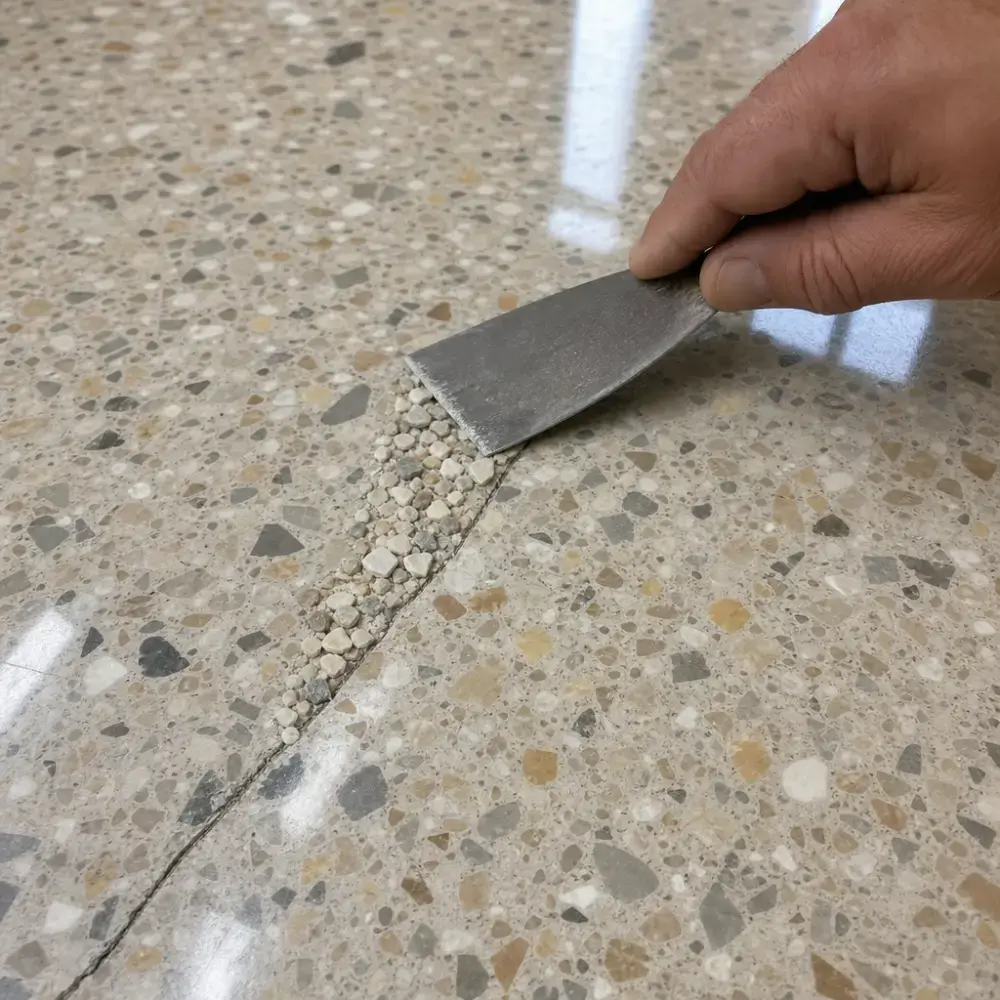
Terrazzo crack and hole repair in Tampa typically runs $75 to $250 per patch, with a full room of tack-strip nail holes priced per room after a look and a repair-only visit carrying a typical $600 to $1,000 minimum. Holes and cracks are cleaned out, filled with marble chips in a matrix tinted to match, cured, and ground flush. When the repair is done as part of a full grind and polish, it blends far better than a spot repair on its own.
Almost every floor that comes out from under carpet needs some of this. The goal is a floor you read as one surface from standing height, with patches you only find if you go looking.
What we repair
Tack-strip holes. Carpet installers nailed strip around every wall, every couple of inches. A typical bedroom ends up with a few hundred small holes around its edge, many with a rust ring. The rust usually grinds out; the holes get filled in one pass and ground flush. Details on the tack-strip holes page.
Larger holes. Old plumbing lines, floor registers that moved, a toilet flange in the wrong place after a bath remodel, the bolts from a floor safe. These are individual patches, each sized and filled.
Cracks. Terrazzo in a house is a thin topping bonded to the slab, which the NTMA’s systems guide says depends on the slab for crack prevention, so it cracks where the slab moves. Many cracks follow a divider strip; others run across a room. The NTMA restoration specification has owner and contractor walk the floor and agree on each crack: no action, repair the crack, or replace the terrazzo. It classes hairline cracks as under 1/32 inch and calls for aggregate in any crack wider than a quarter inch. The cracks page goes deeper.
Wall gaps. Take out a wall in a 1960s block house and you find a strip of bare slab where the wall sat, because the terrazzo was poured around it. That strip is a long patch, filled with chips and matrix and ground in with the rest of the floor. It is its own topic: gap where a wall was removed.
Hollow or lifting sections. Where the topping has lost its bond to the slab, tapping sounds dull and hollow. Those sections are cut out and replaced, ideally from strip to strip. See hollow-sounding terrazzo.
Bent or missing strips. Tile removal, wall removal and plumbing work often bend or tear out sections of divider strip. The NTMA’s systems guide lists zinc and brass as the strip metals for cement terrazzo, so replacements are matched in the same metal and gauge, set in a cut, and ground flush with the floor. See divider strips.
How a patch is made
- Clean out the damage. Loose material, dirt, old filler and sealer come out of the hole or crack. A crack that will be filled with chips is opened enough to take them.
- Match the floor. Chips are picked by color and size from the floor around the repair, and the matrix is tinted to match. Unusual blends take a sample board first. The NTMA recommends mock-ups so expectations are set before work starts, and we do the same on any patch you will see every day.
- Fill and cure. The patch goes in proud of the floor and cures. Cement and epoxy fills have different cure times; we wait.
- Grind flush. The patch is ground down with the surrounding floor through the same grits, then polished and sealed with it.
Where replacement starts
When a section is too broken to patch, the NTMA approach is to replace it to an architectural break, usually the nearest divider strip, or to cut a jagged, saw-tooth edge where there is no strip to stop at. A straight cut across the middle of a panel draws the eye; a strip-to-strip replacement reads as one panel that is a slightly different shade. That is why some repairs look bigger than the damage: they are sized so the edge disappears.
Prices
| Repair | Typical |
|---|---|
| Single small hole | $75 to $125 |
| Larger hole or short crack with chips | $125 to $250 |
| Room of tack-strip nail holes | per room, after a look |
| Section replaced strip to strip | quoted after a look |
| Repair-only visit minimum | $600 to $1,000 |
The per-patch range is the same one on the pricing page. The repair visit estimator adds up patches, stains and sealing if you do not need the whole floor ground.
Repair visit or full restoration?
If the floor is already ground and polished and you need two holes filled, a repair visit makes sense. Be aware that grinding a patch flush on a polished floor leaves a small area at a slightly different polish from the floor around it.
If the floor is dull, coated or still covered, fold the repairs into a full restoration. The patches cost the same, the grind blends them, and you pay the minimum once instead of twice.
Honest expectations
A patch is never invisible on your hands and knees. Chips in your floor came out of a quarry sixty or seventy years ago, and the NTMA restoration specification says plainly that matching existing aggregate may not be exact. From the doorway, a good patch is hard to find. We show you a sample before filling anything in the middle of a room.
Frequently Asked Questions
How much does it cost to patch a hole in terrazzo?
Typically $75 to $250 per patch. A single small hole sits at the bottom; a crack that has to be cut out and filled with matched chips sits at the top. A full room of tack-strip nail holes is priced per room after a look, and a repair-only visit has a typical minimum of $600 to $1,000.
Will a patch match my floor?
We match chip color, chip size and matrix color as closely as we can, and from standing height a good patch is hard to find. Up close it shows. The NTMA restoration specification says color matching existing aggregates may not be exact because they are mined products that change over time.
Should cracks be fixed before or after polishing?
Before. A patch has to cure and then be ground flush with the floor, so repairs go in after the covering comes off and before the grinding passes. Patching after a polish means grinding the patch area again, and it will not blend as well.
Do cracks in terrazzo mean my foundation is failing?
Usually not. A half-inch topping bonded to a slab cracks where the slab cracks, often beside a divider strip that sits over a joint in the concrete. A crack that is still growing, or one with a height difference you can catch a fingernail on, is worth having looked at before patching.