 Tampa Terrazzo Restoration
 Terrazzo Grinding and Polishing in Tampa
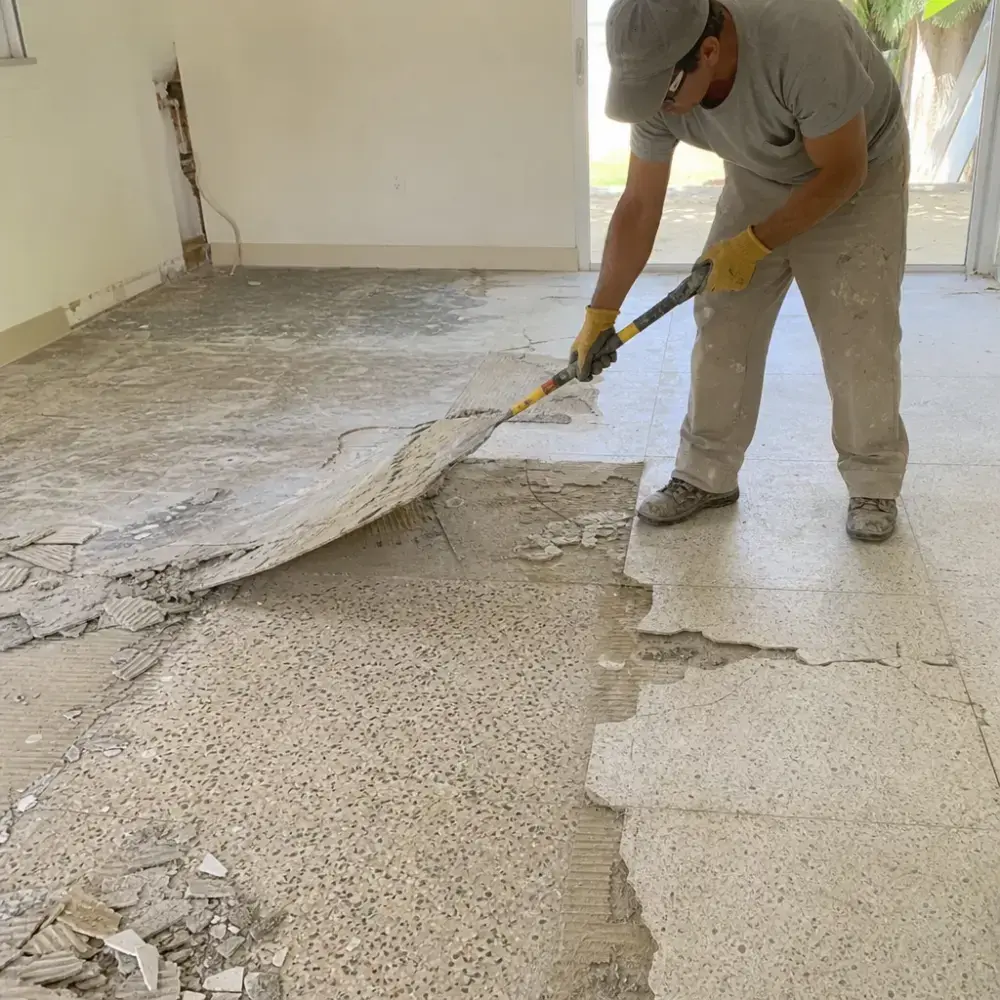
Terrazzo grinding and polishing in Tampa typically costs $5 to $9 per square foot for a full metal-bond grind followed by resin-bond honing and polishing, or $3 to $5 per square foot for a light hone and polish on a floor that is already exposed, flat and sound. Either way the shine is cut into the stone with diamonds and sealed with a penetrating sealer. Nothing is painted on top.
Grinding is the heart of every terrazzo job we do. On a covered floor it is part of a full restoration; on a floor that is already bare but dull, scratched or coated, it is the whole job.
Why grind instead of coat
Because coatings fail and ground stone does not. A coating sits on top of the floor as a film. Foot traffic scratches it, sun from a Florida room yellows it, and water vapor coming up through a slab-on-grade floor gets trapped under it. The NTMA’s care guide tells owners not to use purely surface waxes or all-purpose sealers because they can make floors slippery. A ground and polished floor has nothing on top to fail: the reflection is the flat, fine surface of the marble and cement, protected by a sealer that soaks in.
Tampa’s houses make the point well. Most of the terrazzo here was poured between the mid-1950s and 1970, and plenty of it got an acrylic or wax “shine” treatment at some point since. Those floors come to us cloudy, yellow along the walls and worn gray in the traffic paths, which is what a coating does after a few years. See the dull and etched spots page for the difference between a worn coating and an etched floor.
The passes, start to finish
Metal-bond grinding. Coarse diamond segments set in metal, run on a planetary grinder that spins several heads against each other so it cuts evenly. These passes flatten lippage at the divider strips, cut off glue film, rust rings, tack-strip stains and the dull top skin, and expose fresh chips. A floor with heavy glue or old coatings takes more metal-bond time, which is the main reason a job lands near $9 rather than $5.
Grouting. Grinding opens pinholes and small voids in the cement matrix. A thin grout of matching cement or epoxy is worked into them. The NTMA restoration spec calls for at least 12 hours of curing before the fine grind.
Resin-bond honing. Finer diamonds held in resin take out the scratch pattern left by the metal. The NTMA guide spec shows the fine grind at 120 grit carborundum or 200 grit resin bond. At this stage the floor looks clean and even with a soft sheen.
Polishing. Continuing up through the finer resin grits brings up the reflection. Where to stop is your call:
| Finish | What it looks like | Effect on price |
|---|---|---|
| Honed | Flat, clean, no reflection | Bottom of the range |
| Satin | Soft sheen, hides scuffs well | Lower to middle |
| Semi-gloss | Clear reflection of windows | Middle to upper |
| High gloss | Reflects the ceiling fan | Top of the range |
Satin is what most families end up choosing, because it looks like polished stone without showing every footprint.
Densifying and sealing. A densifier hardens the cement matrix so it polishes better and holds the shine. A penetrating sealer goes on last. The NTMA notes that the Portland cement binder is the part of the floor that benefits most from sealing.
What makes a grind harder
- Large chips and colored matrix. Big chips need more passes before chip and matrix polish to the same level, and colored matrices show pinholes more clearly.
- Lippage at the strips. Where the panels between strips were poured at slightly different heights, flattening takes extra metal-bond work.
- Old coatings. Acrylic and urethane gum up the first diamonds. More passes, more segments.
- Tight rooms. Small baths and closets need edge grinders and hand work.
How much floor there is to grind
A house terrazzo topping is thin. The NTMA defines monolithic terrazzo, the system bonded straight to a slab, as a half-inch nominal topping, and a restoration takes off only a thin skin of it. That is plenty for a careful grind, and a floor can be restored more than once in its life. The record of earlier grinding is in the divider strips: if they stand well above the chips and cement around them, a previous crew took a lot off, and we grind more conservatively. We check the strips before quoting, and the divider strips page explains what to look for.
Light hone and polish: when it is enough
If your floor is already exposed, has no glue or coating, and just looks tired, you may not need the metal-bond passes at all. A light hone and polish, starting in the middle resin grits, typically runs $3 to $5 per square foot. That is the same range a 2026 Tampa cost guide gives for light polishing and maintenance. We will tell you honestly whether your floor is a light-polish floor; most floors that have been under carpet are not.
Prices
| Work | Typical |
|---|---|
| Full grind, hone and polish | $5 to $9 per sq ft |
| Light hone and polish, exposed sound floor | $3 to $5 per sq ft |
| Removal of carpet or tile first | see removal |
| Patching before the grind | $75 to $250 per patch |
| Minimum, one room | $600 to $1,000 |
All of these match the pricing page, and the floor cost estimator puts them together for your floor size.
Keeping the shine
A polished floor stays polished if grit and acid stay off it. Dust mop often, because grit acts like sandpaper underfoot. Damp mop with water and a pH-neutral cleaner. The NTMA care guide warns against degreasers, bleach, vinegar and ammonia. The full routine is on the sealing and maintenance page.
Frequently Asked Questions
What is the difference between grinding, honing and polishing?
Grinding uses coarse metal-bond diamonds to flatten the floor and cut off glue, stains, scratches and the worn surface. Honing uses finer resin-bond diamonds to smooth out the grinding marks. Polishing is the last few fine-grit passes that bring up the reflection. All three are done with diamonds and water, not with a coating.
Can you polish terrazzo without grinding it first?
Only if the floor is already flat, clean and sound, with no glue, deep scratches or lippage at the strips. That is the light hone and polish at $3 to $5 per square foot. A floor coming out from under carpet almost always needs the metal-bond grind first.
How shiny can terrazzo get?
Very, if you want it. The NTMA's guide specification shows a fine grind at 120 grit carborundum or 200 grit resin bond, and residential polishing continues well past that into the fine resin grits. We stop at a satin for most houses and keep going for gloss when asked. The finish comes from the stone and the cement.
Does grinding make a lot of dust?
It can, which is why we grind wet or with vacuum shrouds and a dust collector. OSHA's silica standard lists an integrated water system or the manufacturer's dust collection system as the controls for walk-behind floor grinders. Expect noise and some fine dust at the edges, not a cloud through the house.