 Tampa Terrazzo Restoration
 Terrazzo Floor Restoration in Tampa
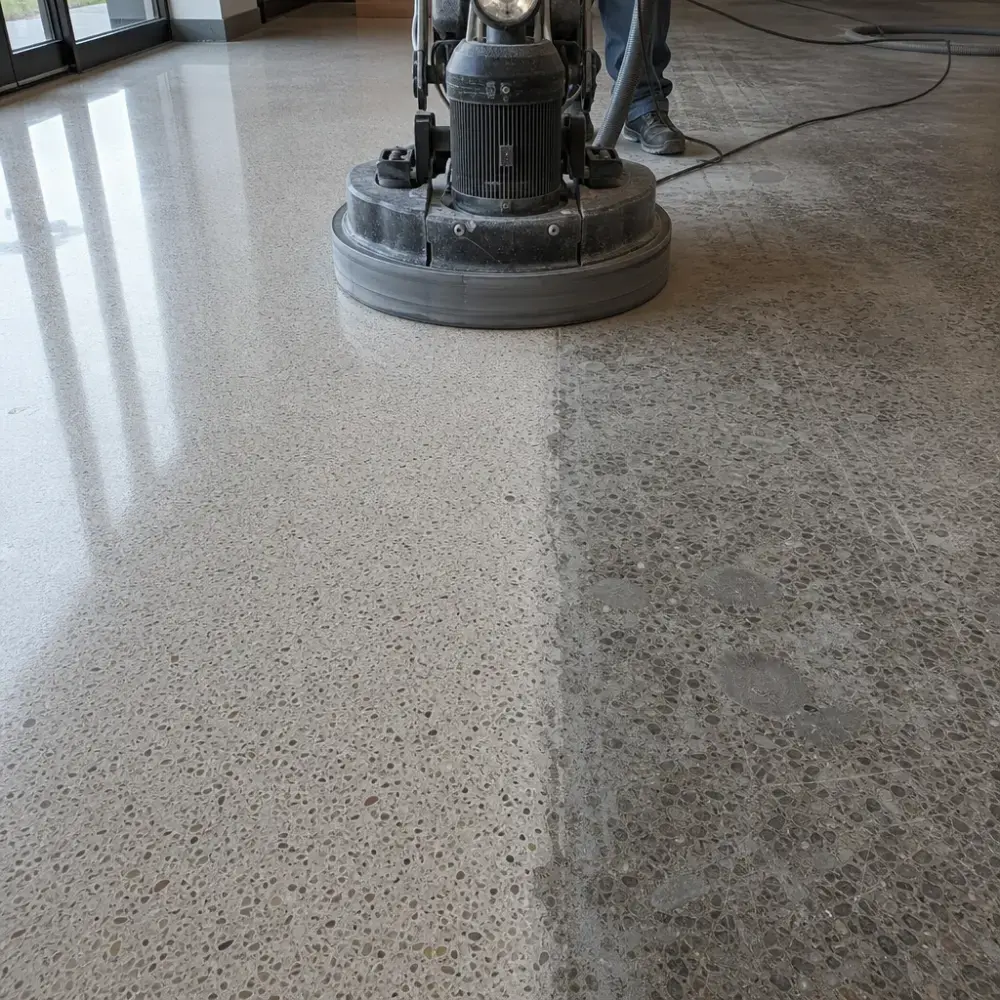
Full terrazzo restoration takes a Hillsborough County floor that has been under carpet, vinyl or tile for decades and returns it to the ground and polished stone it was when the house was new. The grind, hone and polish typically runs $5 to $9 per square foot, removal adds $2 to $3 per square foot for carpet and glue or $4 to $6 for tile and thinset, and patches are $75 to $250 each. A house with 1,000 to 1,500 square feet of carpeted terrazzo typically comes to $7,000 to $18,000. Send a closet-corner photo and we will tell you where yours is likely to fall.
This is the service most Tampa owners mean when they say “restore the terrazzo.” It is not a different technique from our grinding and polishing; it is that work plus everything that has to happen before and after it on a floor that has been covered.
Who this is for
The houses that need it are a narrow band. In our pull of 1,103 Hillsborough property records, every house that listed terrazzo was built between 1954 and 1970, and the mid-century houses that did not list it mostly read carpet, tile or wood. If you own a concrete block house from those years in Town ‘n’ Country, Carrollwood, Temple Terrace or one of the other pockets we cover, there is a reasonable chance the original floor is still under whatever you are walking on.
You need the full restoration, rather than a polish, if any of these are true:
- The terrazzo is still covered, completely or in some rooms.
- There is glue, tack strip or thinset on it.
- It has holes, cracks, or a gap where a wall came out.
- It has an old coating that has gone yellow or is peeling.
- It is dull and scratched all over, not just dirty.
If the floor is already bare and sound and just tired, a light hone and polish at $3 to $5 per square foot may be all it needs. We will tell you which from the photos.
The sequence, in order
1. Remove what is on top. Carpet and pad come up first, then the tack strip. Strip nailed every couple of inches around a room leaves a perimeter of holes, and pulling it straight up keeps the nails from snapping off in the floor. Tile comes up with chisels and a demolition hammer, carefully, because the setter often bonded it straight to the terrazzo. Glue and thinset residue stays for the grinder. Black adhesive from old vinyl tile gets tested for asbestos before anyone grinds it. The removal page goes through each covering.
2. Read the floor. With the covering off we look at the whole slab: chip size and colors, matrix color, divider strips, cracks, hollow spots, old coatings. This is when the firm price is set, and the NTMA restoration specification says it plainly: a contractor may need to reevaluate once substrates are uncovered. We tell you what changed, if anything did, before going on.
3. Repair. Holes and cracks are cleaned out and filled with chips in a tinted matrix. The NTMA spec calls for aggregate in any crack wider than a quarter inch; narrower cracks take a matching filler. Sections that have let go of the slab are cut back to a strip or a jagged edge and replaced. Repairs cure before grinding. Details on the crack and hole repair page.
4. Grind. Planetary grinders with metal-bond diamonds take the floor flat and cut through glue film, rust, shallow stains and the worn top skin. We grind wet or with vacuum shrouds and a dust collector. OSHA’s silica rule for walk-behind floor grinders calls for one or the other, and it is the difference between a dusty house and a ruined one.
5. Grout. A thin cement or epoxy grout fills the pinholes the grind opens up in the matrix. The NTMA spec has it cure at least 12 hours before the fine grind.
6. Hone and polish. Resin-bond diamonds step up through the grits. Stop in the middle for a satin; keep going to the fine grits for gloss. Each step past satin is another pass over the whole floor, which is why gloss sits higher in the range.
7. Seal. A penetrating sealer that soaks into the cement. The NTMA care guide notes that the Portland cement binder is the part of the floor that benefits most from a sealer, and it warns against purely surface waxes. Then care instructions: plain water and a pH-neutral cleaner, nothing acidic.
What it costs, line by line
| Line | Typical |
|---|---|
| Grind, hone and polish | $5 to $9 per sq ft |
| Carpet, pad, strip and glue removal | $2 to $3 per sq ft |
| Tile and thinset removal | $4 to $6 per sq ft |
| Patches | $75 to $250 each |
| Tack-strip perimeters | per room, after a look |
| Stain treatment that survives the grind | $150 to $600 per area |
| Sealing | included in the restoration |
| Whole house, 1,000 to 1,500 sq ft carpeted | $7,000 to $18,000 |
The pricing page works through a typical 1,200 square foot Carrollwood house line by line, and the floor cost estimator does it for your floor.
What the finished floor looks like
Like a well-kept 1960 terrazzo floor: flat, evenly polished, the chips crisp, the strips bright. What it will not look like is a factory-new floor poured last week. Expect three honest limits:
- Patches show up close. The NTMA says matching existing chips may not be exact because marble is a mined product. From standing height you will struggle to find them. On your knees you will.
- Deep stains may only fade. Pet urine and old oil that soaked into the cement are the usual ones. The NTMA restoration spec notes that all staining in existing terrazzo may not be possible to remove.
- Strips tell the floor’s history. Bent or missing strips can be replaced, but a floor that was trenched for a drain line will show it.
Living in the house during the work
Most people stay. We work room by room, move furniture as we go, and keep the grinding wet or vacuumed. It is loud and the house will feel like a job site while we are there. If you are between owners, between tenants or about to move in, that is the cheapest and fastest moment to do it because nothing needs moving.
After a flood
If the covering came off because storm water ruined it, as it did in many low Hillsborough neighborhoods after Helene in September 2024, the order changes: rinse the salt and silt off first, let the slab dry, test moisture, then restore. That is on its own page: flood-damaged terrazzo restoration.
Frequently Asked Questions
What is included in a full terrazzo restoration?
Everything from the covering down: carpet, pad, tack strip, tile and glue removal, patching holes and cracks with matched chips, metal-bond grinding to flatten the floor and cut off stains, resin-bond honing and polishing to the finish you choose, and a penetrating sealer. It is priced as a grind at $5 to $9 per square foot plus removal and repair lines.
How long does a whole-house restoration take?
It depends on the covering and the repairs. A Tampa cost guide puts most terrazzo projects at two to five days on the floor. Tile removal and patches that need to cure before grinding add time, and so does working around furniture. We give you a schedule with the written quote.
Is there enough terrazzo left to grind?
Usually plenty. A house topping is roughly half an inch of chips and cement, and a restoration takes off a thin skin. The warning sign is divider strips standing well above the floor around them, which means an earlier crew already ground hard. We check that before quoting.
Should I restore before selling or let the buyer do it?
An exposed, polished terrazzo floor photographs as stone, and carpet over it photographs as old carpet. If you are listing a mid-century house and the floor underneath is sound, restoring it in an empty house is the cheapest it will ever be. If time is short, pulling one closet corner so buyers can see it is the minimum.